Unveiling new products, innovative solutions, case studies, and industry updates
ClairWav Radar Application Case Study: Dynamic Green Wave Traffic Control in Yuncheng County
Background
In recent years, Yuncheng County has faced increasing traffic pressure due to the intertwined development of old and new urban areas. With hospitals, schools, residential communities, and commercial establishments concentrated in the area, major roads and key intersections frequently experienced severe congestion, significantly impacting residents' daily travel and the city's overall development. The local traffic management authority sought an intelligent solution to address these challenges.
The Challenge
The mixed urban layout—combining old and new districts with dense commercial and public facilities—created complex traffic dynamics that traditional fixed-timing signal systems could not effectively manage. Peak-hour congestion was a persistent problem, causing delays, secondary stops, and reduced traffic efficiency across the road network.
The Solution
A comprehensive intelligent traffic signal optimization system was deployed across 64 intersections in the county. The solution leveraged ClairWav microwave radar detectors as the core sensing technology to enable real-time, data-driven traffic management.
Key Technical Components
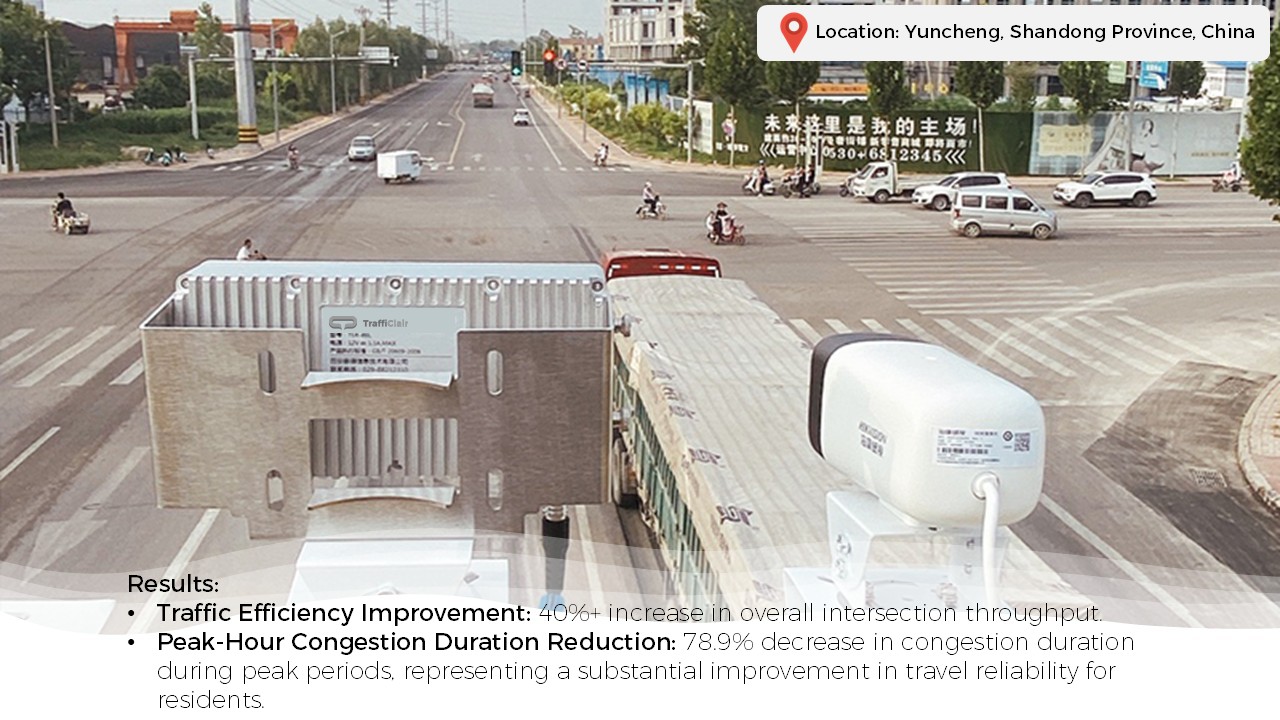
ClairWav Radar Deployment: ClairWav series traffic control radars were installed at each optimized intersection. These radars provide high-precision, non-intrusive detection of vehicle positions, speed, lane occupancy, traffic volume, and queue length in real time. With detection ranges up to 700 meters and the ability to track up to 512 objects simultaneously, the radars deliver the accurate, millisecond-level data essential for dynamic signal control.
Green Wave Network Architecture: The system implements a "3 horizontal, 1 vertical, and 1 intersecting" green wave network—a coordinated arterial control strategy covering the county's core road corridors. This architecture enables:
Real-time monitoring of traffic conditions across the entire road network
Dynamic green wave control that adjusts signal timing based on real-time vehicle speed and arrival patterns
Automated incident response through corridor-based coordination
Adaptive Signal Control: Leveraging radar-detected traffic parameters, the system automatically adjusts signal cycles based on real-time traffic demand, eliminating inefficiencies such as empty green lights and excessive secondary stops at intersections. The control algorithm employs a feedback-based optimization model that continuously works to minimize intersection traffic density.
Results
The deployment has delivered significant improvements in traffic performance:
Traffic Efficiency Improvement: 40%+ increase in overall intersection throughput
Peak-Hour Congestion Duration Reduction: 78.9% decrease in congestion duration during peak periods, representing a substantial improvement in travel reliability for residents
These results demonstrate the effectiveness of combining ClairWav radar-based detection with dynamic green wave coordination and adaptive signal control. By providing precise, real-time traffic data, ClairWav radars enable the system to respond to actual traffic conditions rather than relying on fixed timing schedules, significantly improving traffic flow in Yuncheng County's mixed urban environment.